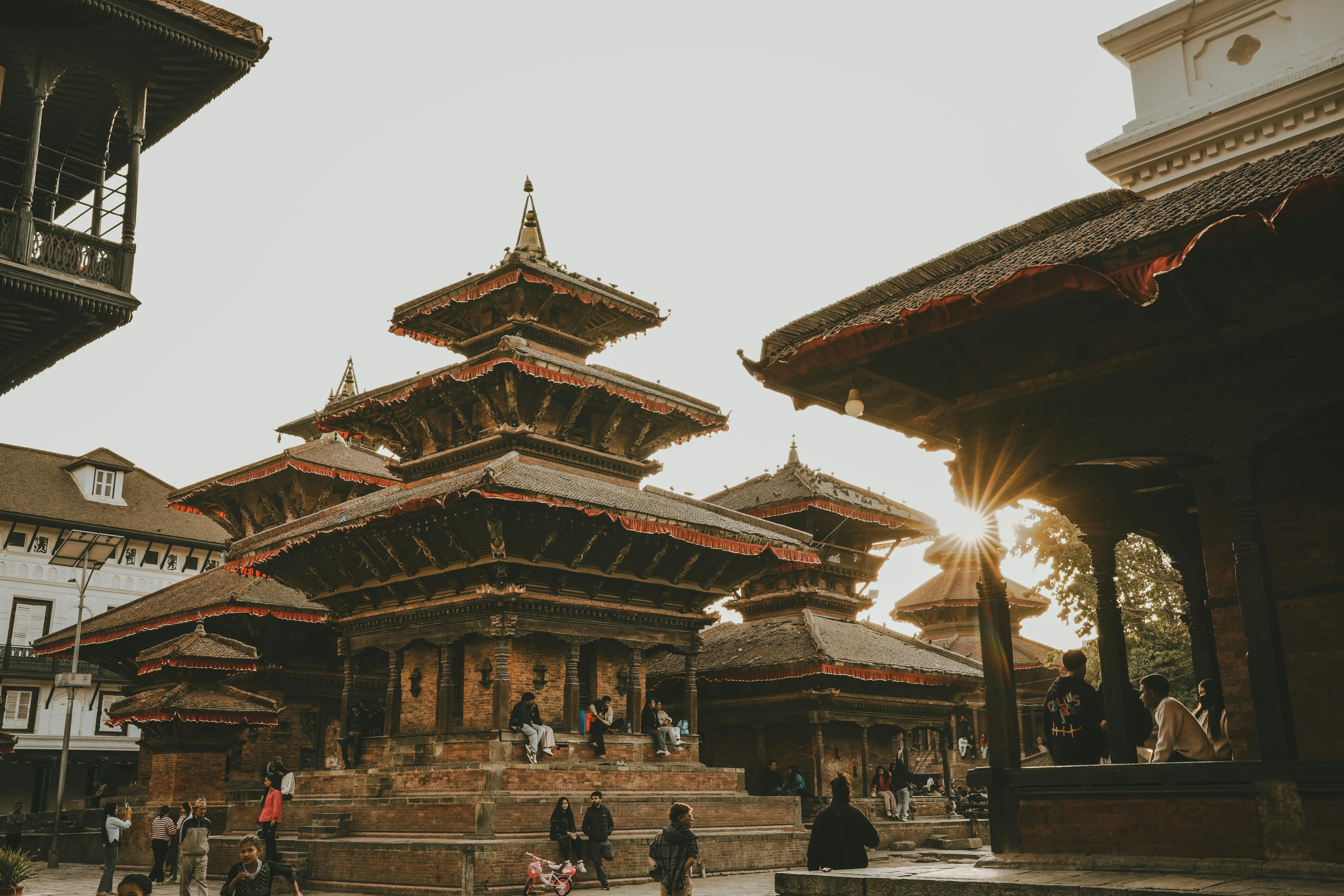
Stand in Kathmandu Durbar Square as the sun begins to set and something quietly remarkable becomes clear. The tiered pagoda roofs, the deep timber eaves, the warm brickwork softened by centuries of monsoon and sun — none of it feels old in the way a museum feels old. It feels alive. People sit on the temple plinths. Children chase pigeons across the stone. The buildings are not artifacts. They are still doing their work.
This is the quiet genius of traditional Nepali architecture, and it is something the modern design world is only now beginning to relearn.
A Vernacular Built on Climate, Not Catalogue
Long before the language of "sustainable architecture" existed, the master craftsmen of the Kathmandu Valley were already practicing it. The Newar pagoda is not stylistic — it is functional. Those wide, layered eaves that give the temples their unmistakable silhouette are designed to shed the heavy rains of the monsoon while shading the brick walls below from direct summer sun. The thick brick-and-timber construction holds heat through cool mountain nights and stays cool through warm afternoons. The orientation, the courtyards, the small carved windows — every element is a response to wind, light, and weather.
Modern architecture spent much of the twentieth century trying to defeat climate with glass walls and mechanical cooling. The Newar builders, working with what their valley gave them, simply listened to it. The result is a vernacular that performs, environmentally, in ways most contemporary buildings still struggle to match.
The Courtyard as a Way of Life
Walk into any traditional Newar home and you will find a chowk — an inner courtyard, open to the sky, around which the rest of the house is organized. The courtyard is not leftover space. It is the heart of the dwelling. It brings light deep into rooms that would otherwise be dark, allows hot air to rise and escape, creates a private microclimate, and gives the family a sheltered communal space that is neither fully inside nor fully outside.
This idea — that a building should be organized around a quiet, open void rather than around its walls — is one of the most powerful lessons traditional Nepali design offers. Contemporary architects from Mexico City to Marrakech have rediscovered the courtyard in recent decades. In the Kathmandu Valley, it never left.
Craft as a Form of Memory
Look closely at the carved wooden struts holding up a temple roof, the latticed ankhi jhyal windows, the patterned brickwork. None of it is mass-produced. Each element carries the hand of the artisan who made it. This is what gives Kathmandu's heritage architecture its particular warmth — the unmistakable presence of human craft, embedded in the building itself.
For modern projects, the lesson is not to copy traditional motifs. It is to honor the same principle: that buildings carrying the trace of skilled human hands age differently, and more beautifully, than buildings assembled from anonymous industrial parts. A custom timber screen, a hand-finished lime plaster wall, a locally forged metal detail — these small gestures carry centuries of craft tradition into contemporary work without resorting to pastiche.
What Modern Nepali Architecture Can Become
There is a particular opportunity for architects working in Nepal today. The country sits at a rare crossroads — a place where vernacular wisdom has not yet been forgotten, where master craftsmen are still practicing, and where the global appetite for thoughtful, slow, place-rooted design is growing rapidly. The next generation of architecture in Kathmandu does not need to choose between heritage and modernity. It can quietly inherit from one and contribute to the other.
This means designing homes that learn from the courtyard without imitating the temple. It means using local brick, timber, and stone because they perform beautifully — not because they look traditional. It means treating restoration of existing Newar structures as a serious discipline, and treating new construction with the same long-time-horizon respect the old builders had.
About Innate
Innatedra is a multi-disciplinary architecture studio crafting slow, intentional spaces where landscape, light, and material come into quiet dialogue. From contemporary residential architecture and bespoke interior design to thoughtful space planning and sensitive heritage restoration, our studio delivers a holistic design journey rooted in permanence. Based in Kathmandu and working on commissions globally — with a strong portfolio across Kathmandu, Bhaktapur, and Nagarkot — Innatedra partners with private clients, hospitality brands, and heritage stakeholders to create buildings that age gracefully and interiors that feel timeless. Whether you are seeking a minimalist residential architect, a hospitality interior designer, or a heritage renovation specialist, Innatedra brings craftsmanship, ecological awareness, and human-scale design to every project we accept.
Designing Within a Living Tradition
At Innatedra, working in Kathmandu, Bhaktapur, and Nagarkot has shaped how we think about architecture more broadly. The valley teaches a kind of patience — a willingness to design slowly, to listen to context, to choose materials that will weather rather than wear out. Whether the commission is a contemporary residence in the hills, a hospitality interior in the old city, or the careful restoration of a heritage property, we approach the work as a continuation of a tradition that has been building beautifully in this valley for centuries.
If you are considering a project rooted in Nepal — modern or heritage, residential or hospitality — we would be honored to begin the conversation.